E-flute vs B-flute pizza boxes: which board should your pizzeria use?
E-flute pizza boxes are thinner, print crisper and store in less space; B-flute is twice as thick and warps less from steam. How to choose by pizza size.
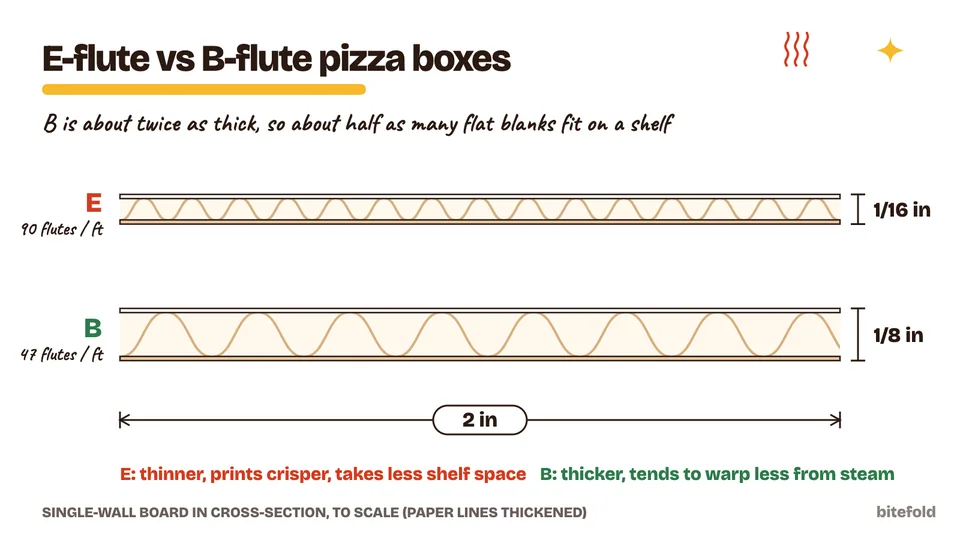
E-flute and B-flute are the two corrugated boards most pizza boxes are made from. E-flute is about 1/16 inch thick, so it prints crisper and its flat blanks take about half the storage space. B-flute is about 1/8 inch thick and tends to warp less from pizza steam. Box design and paper weight matter as much as the flute.
What does "flute" mean on a pizza box?
Corrugated board is a sandwich: two flat paper sheets, called liners, glued to a wavy sheet in the middle, called the medium. The waves are the flutes. Wikipedia's article on corrugated fiberboard explains that the common flute sizes carry the letters A, B, C, E and F, and that "the letter designation relates to the order that the flutes were invented, not the relative sizes." So B is not "one step up" from A, and E is not the thickest.
Flute size is set by how many waves fit in a foot. The standard US flute table in the same article (citing the Wiley Encyclopedia of Packaging Technology) gives:
| Flute | Flutes per foot | Board thickness |
|---|---|---|
| A | 33 ± 3 | 3/16 in (4.8 mm) |
| B | 47 ± 3 | 1/8 in (3.2 mm) |
| C | 39 ± 3 | 5/32 in (4.0 mm) |
| E | 90 ± 4 | 1/16 in (1.6 mm) |
| F | 125 ± 4 | 1/32 in (0.8 mm) |
The article adds that counting flutes per foot is a more reliable way to identify a board than measuring its thickness, which "can vary due to manufacturing conditions."
Which flute do pizza boxes use?
Both. Wikipedia's pizza box article says the corrugated board in use is "often of the E flute size," and that "thicker B flute cardboard" is also used. An archived industry guide from Correll Concepts, a pizza packaging design firm, puts it the same way: "Most corrugated pizza cartons come in either B-flute or E-flute board," with B-flute "about 1/8-inch thick" and E-flute "about 1/16-inch thick, or half as much."
Our own printed pizza box is E-flute corrugated, in kraft or white, which is the common choice for 10 to 16 inch pies.
What are the advantages of E-flute pizza boxes?
- Sharper printing. Wikipedia notes that finer flutes such as E "provide smoother printing surfaces for high-resolution graphics." The Correll guide says E-flute "tends to print up slightly better." Fewer, smaller waves mean less of a washboard under your logo.
- Less storage space. The Correll guide says E-flute "saves almost 50 percent in box blank storage space over B-flute." Wikipedia's pizza box article goes further on the flat blanks: boxes from solid fiberboard take "about half the space" of E-flute boxes "and a quarter of the space of those made of B flute size cardboard." For a small kitchen where flat boxes live on one shelf, that is a real difference.
- Lighter boxes. Thinner board means a lighter blank, which helps when a driver carries a tall stack.
What are the advantages of B-flute pizza boxes?
- Less warping from steam. The Correll guide lists as B-flute's first advantage that "it tends to warp less from pizza steam than does E-flute." That matters for large, wet or heavily topped pizzas that sit in the box for a while.
- More crush resistance, all else equal. The same guide says "B-flute board tends to have more crush-resistance than E-flute," which helps when loaded boxes are stacked in a delivery bag or on a pickup shelf.
- A heavier feel. The guide also notes that "some folks believe that the thicker board connotes higher quality." That is a perception, not a performance number, but it is part of why some pizzerias pick B.
Does thicker board keep pizza hotter?
Not necessarily. The Correll guide says some people assume B-flute retains heat better because it is thicker, but "research by at least one box manufacturer refutes this." The guide does not name the study, so treat it as an industry note rather than a measured result. What is better documented is that a pizza box has two jobs that pull against each other: Wikipedia's pizza box article explains that the box should keep warm air in, yet the condensation from the pizza "must be let out (airing holes and some diffusion through the cardboard) or absorbed by the box," or the crust goes soggy. Vents and closure design affect that more than the flute letter.
Is the flute or the box design more important for stacking strength?
The design. The Correll guide says stacking strength depends on "(a) the structural design of the carton and (b) the flute and paper weight of the corrugated board," and that "structural design plays the biggest role." It goes as far as saying that one box design in lighter E-flute can stack better than another design in heavier B-flute.
Paper weight is the other half. The guide explains that "the heavier the paper, the stronger the corrugated board" and the more it costs, and gives one typical pizza board as "125 lb test board" with 26 lb liners. The point for a buyer: B-flute made from light paper is not automatically stronger than E-flute made from heavier paper, because, in the guide's words, "the flute size has nothing to do with paper thickness, or weight."
E-flute or B-flute: which should your pizzeria choose?
A practical way to decide, as a rule of thumb built from the points above:
| If your situation is... | Lean toward |
|---|---|
| 10 to 14 inch pizzas, crisp crust, quick pickup or short delivery | E-flute |
| Full-color logo, photos or fine type on the lid | E-flute |
| Very little storage space for flat blanks | E-flute |
| 16 inch or larger, heavy or saucy pies, long delivery runs | B-flute (ask in your quote) |
| Boxes stacked high in bags or on a heated shelf | B-flute, or a stronger box design |
You can also mix them. The Correll guide notes a pizzeria "can have its larger boxes (ex., 14-inch and 16-inch) made of B-flute and its smaller ones (10-inch and 12-inch) made of E-flute." If you are still choosing sizes, our pizza box sizes chart shows which box fits each pie.
Does white or kraft board change anything?
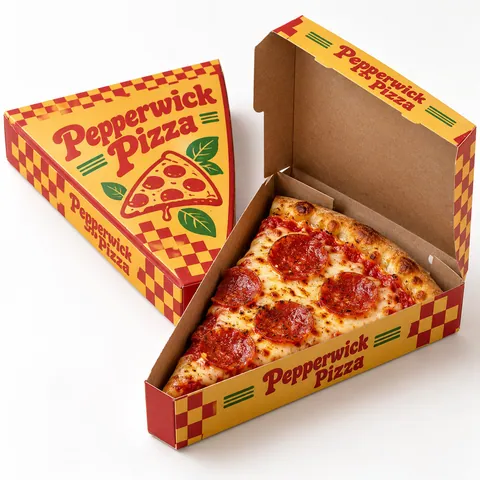
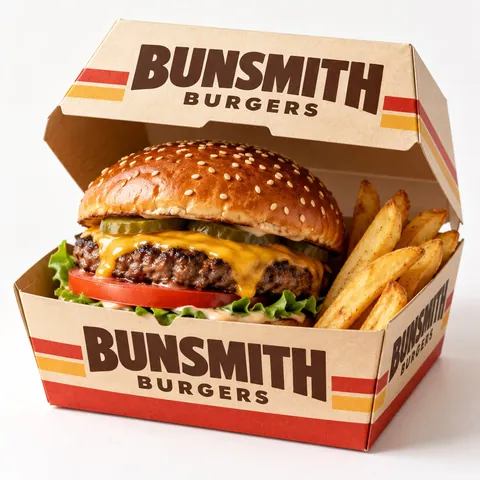
It changes the print, not the flute. The Correll guide says white liner "displays color printing better," while kraft (brown) liner is "less expensive," and that many companies use white outside for the print and kraft inside. Our pizza boxes come in kraft or white, printed outside (inside on request). For slices, our pizza slice boxes use folding paperboard or micro-flute, and burger joints often pair pizza boxes with burger boxes in the same print.
Every order comes with free digital design and dieline, a digital proof before printing, and no minimum order quantity: order 1 piece or 10,000. Tell us your pizza sizes and delivery setup in a quote request and we will suggest the board. More for pizzerias and delivery kitchens on our restaurants page.
FAQ
Is E-flute strong enough for a pizza box?
Yes for most pizzas. Wikipedia's pizza box article says pizza boxes often use E-flute board. For very large or heavy pies, or tall stacks, B-flute or a stronger box design is worth asking about.
How thick is E-flute compared with B-flute?
The standard US flute table gives E-flute as 1/16 inch (1.6 mm) with about 90 flutes per foot, and B-flute as 1/8 inch (3.2 mm) with about 47 flutes per foot. B is roughly twice as thick.
Does B-flute keep pizza hotter than E-flute?
Not reliably. An archived industry guide says research by a box maker refuted that idea. Venting and closure design do more for crust and temperature than the flute letter.
Can I use E-flute for small pizzas and B-flute for large ones?
Yes. Mixing flutes by size is a common approach: thinner board for 10 and 12 inch boxes, thicker board for 14 and 16 inch boxes.
Sources
- Wikipedia, "Corrugated fiberboard" (flute sizes and the standard US flute table), read 10 Nov 2026: https://en.wikipedia.org/wiki/Corrugated_fiberboard
- Wikipedia, "Pizza box" (materials and transport sections), read 10 Nov 2026: https://en.wikipedia.org/wiki/Pizza_box
- Correll Concepts, "Pizza Packaging, Structural Options, Pros & Cons" (Internet Archive copy of 19 Aug 2012), read 10 Nov 2026: https://web.archive.org/web/20120819160624/http://www.correllconcepts.com/Pizza_Packaging/structural%20_options.htm
- Bitefold pizza box product page (board and print options), read 10 Nov 2026: https://www.bitefold.com/products/pizza-boxes/
Related pages
See your logo on it first
Send your logo and the item you need: we reply with a free digital design and a price, then a digital proof before anything prints.