Paperboard points (pt) explained for bakery and food boxes
One point (pt) is one thousandth of an inch of board thickness. What 12, 14, 18 and 24 pt mean for bakery and food boxes, and why stiffness matters more.
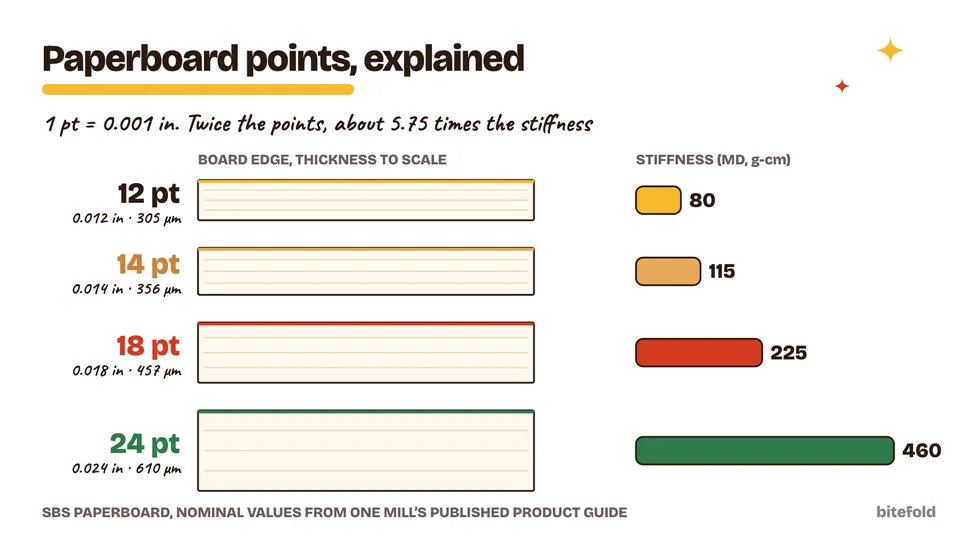
A point (pt) is a thickness unit for paperboard: one point is one thousandth of an inch, so 18 pt board is 0.018 inch, or about 457 microns, thick. Points measure caliper only, not weight or strength. For bakery and food boxes, a few extra points add much more stiffness than thickness.
What does "pt" mean on a paperboard box?
"Pt" is short for point, and in North American paperboard it is the board's caliper, its thickness, counted in thousandths of an inch. Wikipedia's paperboard article gives the example directly: "a sheet of paperboard with a thickness of 0.024" would be 24 points." You will also see the same number written as mils. One mill's product guide for its solid bleached sulfate (SBS) board heads its caliper row "mils" and describes the same range in the text as "10pt to 28pt," so on a spec sheet the two words mean the same thing.
The same guide lists the metric thickness next to each caliper. A few of its nominal values:
| Caliper | Inches | Microns (metric thickness) |
|---|---|---|
| 12 pt | 0.012 in | 305 µm |
| 14 pt | 0.014 in | 356 µm |
| 18 pt | 0.018 in | 457 µm |
| 24 pt | 0.024 in | 610 µm |
When does paper become paperboard?
There is no single hard line. Wikipedia describes paperboard as "generally thicker (usually over 0.30 mm, 0.012 in, or 12 points)" than paper, and by weight as "a paper with a grammage above 250 g/m2, but there are exceptions." The exceptions are real: the mill guide above starts its folding carton range at 10 pt. For box buyers the point is simple: anything you would call a folding box, from a cookie box to a sandwich box, sits in the paperboard range, and the number in front of "pt" tells you how thick it is.
Is 18 pt thick enough for a bakery box?
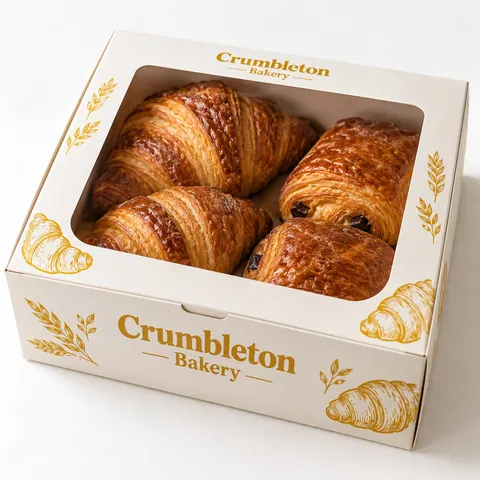
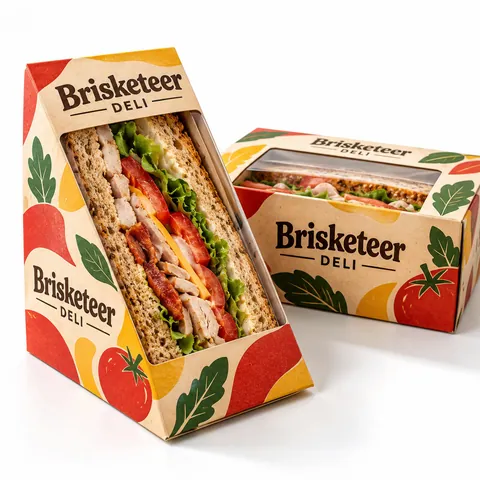
For most single-layer bakery boxes it is the common middle choice. Our own printed bakery boxes are 18 pt card with a window lid, and several of our takeout boxes, such as sandwich boxes, are 18 pt SBS paperboard. The mill guide we read lists "confectionery and bakery boxes" among the uses for its 10 to 28 pt coated board, so there is no single correct caliper for every bakery item.
A rule of thumb rather than a standard: go up in caliper when the box is large, the contents are heavy or the box will be stacked, and stay lower when the box is small and light, such as a single cookie or macaron box. When you are unsure, ask for the stiffness value, not just the points.
Why does stiffness grow faster than thickness?
This is the part most buyers miss. Thicker board is much stiffer than its caliper suggests. In the same SBS product guide, nominal machine-direction bending stiffness is:
- 12 pt: 80 g-cm
- 14 pt: 115 g-cm
- 18 pt: 225 g-cm
- 24 pt: 460 g-cm
Going from 12 pt to 24 pt doubles the thickness but makes the board about 5.75 times as stiff in that direction (80 to 460). Going from 14 pt to 18 pt adds under a third more thickness and roughly doubles the stiffness (115 to 225). The guide also lists a cross-direction value for each caliper, and it is lower: 40 g-cm at 12 pt and 230 g-cm at 24 pt. That is why a box designer cares which way the board grain runs across the lid and walls.
In practice, a small step up in points is often the cheapest way to stop a wide cake or pie box lid from bowing, and a small step down can be fine for light pastries.
Do two boards with the same points weigh the same?
No. Points measure thickness, and different board types pack different amounts of fiber into that thickness. Two guides from the same mill show it:
- Its SBS board at 18 pt has a nominal basis weight of 199 lb per 3,000 sq ft, which works out to about 66 lb per 1,000 sq ft.
- Its coated recycled board (CRB) at 18 pt is listed at 74 lb per 1,000 sq ft, or 360 g/m², at the same 457 micron thickness.
So at 18 pt the recycled board is about 12% heavier per square foot than the SBS board. Note the different units too: one guide quotes basis weight per 3,000 square feet, the other per 1,000 square feet. When you compare quotes, make sure the units match before you compare numbers, and do not read a higher weight as a thicker or stiffer board.
How exact are the points on a spec sheet?
They are nominal. The CRB guide gives a caliper tolerance of plus or minus 1 mil (plus or minus 5% in metric). The SBS guide says its board "is tightly controlled to caliper" while "basis weight may vary by production run," and both guides say their values are typical and can change. So a box sold as 18 pt can measure a hair over or under 0.018 inch, and that is normal.
How should a bakery or restaurant pick a caliper?
Start from what goes in the box, then check the spec:
- Size and weight of the contents. A half-dozen cupcakes or a whole cake needs more stiffness than one cookie.
- Lid span. Wide lids sag first; stiffness matters more than thickness here.
- Stacking and delivery. Boxes that ride stacked in a car or on a bike need stiffer board or a sturdier style.
- Window or no window. A window cut-out removes board from the lid, so a slightly heavier caliper can help.
- Ask for numbers. Points, board type, and if possible the stiffness value.
For a quick look at the boxes bakeries order most, see our bakery packaging page. To price a box in the caliper you want, get a quote: there is no minimum order, every order comes with free digital design and dieline, and you approve a digital proof before printing.
FAQ
How thick is 18 pt paperboard?
18 pt is 0.018 inch. One mill's product guide lists its 18 pt SBS board at 457 microns, a little under half a millimeter.
Is pt the same as mil?
On paperboard spec sheets, yes. Both mean one thousandth of an inch of caliper. One SBS mill guide labels the caliper row "mils" and describes the range as 10pt to 28pt.
Is 24 pt twice as strong as 12 pt?
It is stiffer than that. In one mill's published values, 24 pt SBS has about 5.75 times the machine-direction bending stiffness of 12 pt (460 vs 80 g-cm), even though it is only twice as thick.
Does a heavier board mean a thicker board?
Not always. At the same 18 pt caliper, one mill lists its coated recycled board at 74 lb per 1,000 sq ft and its SBS board at about 66 lb per 1,000 sq ft. Weight and thickness are separate measurements.
What caliper are Bitefold bakery boxes?
Our printed bakery boxes are 18 pt card with a window lid. If your item is unusually large or heavy, say so in your quote request and we will suggest a board.
Sources
- Wikipedia, "Paperboard" (thickness in points, the paper vs paperboard line, board types), read 11 Nov 2026: https://en.wikipedia.org/wiki/Paperboard
- Clearwater Paper, "Candesce Product Guide" (SBS paperboard: caliper in mils, microns, basis weight, MD and CD stiffness, uses), read 11 Nov 2026: https://s24.q4cdn.com/913789668/files/design/2025/05/Candesce-Product-Guide_2025_Website_1.pdf
- Clearwater Paper, "Circa Carton Product Guide" (coated recycled board: caliper, tolerance, basis weight), read 11 Nov 2026: https://s24.q4cdn.com/913789668/files/doc_downloads/2026/07/Circa-Carton-Product-Guide.pdf
- Bitefold bakery box product page (board and window options), read 11 Nov 2026: https://www.bitefold.com/products/bakery-boxes/
Related pages
See your logo on it first
Send your logo and the item you need: we reply with a free digital design and a price, then a digital proof before anything prints.