Cup sleeve vs double-wall cup: which one does your café need?
Cup sleeve or double-wall cup? How each one keeps hands off the heat, what each costs you in stock and space, and which suits your café.
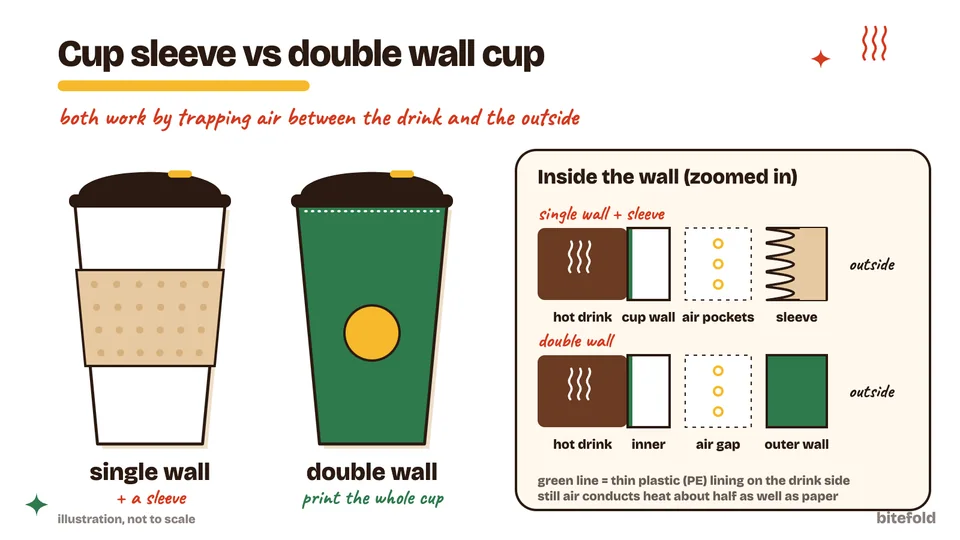
A cup sleeve and a double-wall cup both stop a hot paper cup from burning hands, by putting still air between the drink and the hand. A sleeve goes on a single wall cup only when needed and cheaply brands stock cups; a double-wall cup has the air gap built in and gives you the whole cup to print.
Which one fits your café depends on how many hot drinks you sell, how much storage you have, and how much of the cup you want covered in your brand. Here is how each works and how to choose.
How does a cup sleeve keep your hand cool?
A cup sleeve is a band of paperboard that slides over a handle-less paper cup. Wikipedia's article on the cup sleeve describes them as "roughly cylindrical sleeves that fit tightly over handle-less paper coffee cups to insulate the drinker's hands from hot coffee", usually made of textured paperboard. They go by many names: coffee clutches, cozies, jackets, collars and zarfs.
The texture is the point. The original US patent for the cardboard coffee sleeve (US 5,425,497, "Cup holder", filed in 1993 and granted on June 20, 1995 to Jay Sorensen) describes a sheet with "multiple nubbins and depressions" that reduce the surface touching the cup and leave air gaps between the sleeve and the cup wall. Less contact and more trapped air means less heat reaches your customer's fingers.
Sleeves were invented to replace double-cupping, the habit of nesting two paper cups for one hot drink. A sleeve does the same job with a strip of board instead of a whole second cup.
How does a double-wall cup work?
A double-wall cup is two paper cups in one: an inner cup that holds the drink, an outer wall around it, and a layer of air between the two. The outer wall never touches the drink. Insulated cups with a corrugated or ribbed outer layer work the same way, with the ribs holding the air.
Why air? Still air is a poor conductor of heat. Engineering Toolbox lists the thermal conductivity of air at about 0.026 W/(m K) at 25 °C and paper at about 0.05 W/(m K), so a layer of still air passes heat roughly half as well as the same thickness of paper. That is the whole trick behind both options in the diagram above.
In both cases the drink side of the cup is the same: paperboard with a very thin plastic lining, usually polyethylene (PE), that keeps the cup from leaking or soaking through.
Sleeve or double wall: how do they compare?
| Single wall cup + sleeve | Double-wall cup | |
|---|---|---|
| Comfort to hold | Good where the sleeve sits | Good over the whole outer wall |
| Where your brand goes | The sleeve (and the cup, if printed) | The whole outer wall |
| Stock to keep | Two items: cups and sleeves | One item |
| Speed at the bar | One extra step per hot drink | Grab and pour |
| Flexibility | Sleeve only on hot drinks that need it | Every drink in that cup gets the extra wall |
| Material per drink | One cup wall plus a band of board | Two full walls |
| Stacking | Cups nest tightly; sleeves ship flat | Taller stacks for the same count |
The last two rows are worth a moment. A double-wall cup uses more paperboard than a single wall cup, because it has two full walls. Sleeves are made and stored flat, so a case of sleeves takes up little room, and plain single wall cups nest tightly. If your back room is small, that matters.
When is a sleeve the better choice?
A sleeve usually makes sense when:
- You sell a mix of hot and warm drinks. A cortado or a kids' hot chocolate may not need a sleeve; a large drip coffee does. With sleeves you add the extra layer only where it is needed.
- You want branding without printed cups. A printed sleeve on a plain stock cup puts your logo in every customer's hand. Our coffee cup sleeves come in kraft or white and fit 12 to 16 oz cups.
- You are testing a seasonal look. Changing a sleeve design is a smaller order than changing a full cup.
- Space is tight. Flat sleeves and nested single wall cups are easy to store.
The trade-off is one extra motion per drink at the bar, and two items to keep in stock and reorder.
When is a double-wall cup the better choice?
A double-wall cup usually makes sense when:
- Most of your sales are hot drinks to go. If nearly every cup would get a sleeve anyway, building the air gap into the cup saves a step on every order.
- You want the whole cup as your billboard. The outer wall is one large print area, with nothing covering the middle of the design.
- Speed matters. Drive-thru windows and busy morning counters benefit from one less step.
- You want one item to manage. One cup per size, nothing to pair it with.
Our paper coffee cups are printed to order as single or double wall, so you can compare both in one quote.
Can you mix both?
Yes, and many cafés do. A rule of thumb, not a standard:
- Double-wall for the size you sell most hot, often the 12 or 16 oz.
- Single wall plus a sleeve for the others, so a small espresso drink does not get a cup it does not need.
- Single wall without a sleeve for cold drinks only if the cup is made for cold drinks; hot cups and cold cups are built differently, so check the spec sheet.
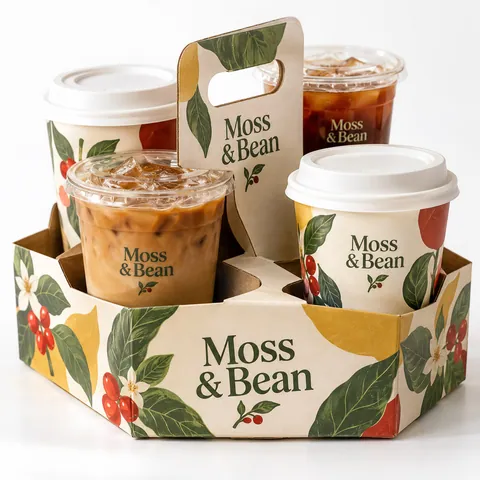
If you sell many drinks in fours for offices, also check that your cup carriers hold your chosen cup. A double-wall cup and a sleeved cup are both a little wider in the hand than a bare single wall cup.
What should you check before you order?
- Fit. A sleeve is sized to a range of cups. Slide one onto the exact cup you use and check it sits snugly without riding up.
- Lid fit. Lids match the rim diameter, not the ounces. Our guide to hot cup sizes and the lids that fit them explains how to read a spec sheet.
- Print area. Ask for the flat dieline for the sleeve or the cup wrap. Every order starts with a free digital design and dieline, and you approve a digital proof before anything is printed.
- Cost per drink. Ask for both options in the same quote, then add the sleeve price to the single wall cup price before you compare. Shipping is quoted separately and added to your invoice.
Our café packaging page lists the cups, sleeves and carriers coffee shops usually order together.
FAQ
Do you need a sleeve on a double-wall cup?
Usually not. The outer wall and the air gap do the job a sleeve does. Some cafés still add a printed sleeve for a promotion, but it is not needed for comfort.
Why do coffee sleeves have bumps or ridges?
The texture leaves small air pockets between the sleeve and the cup, and air conducts heat poorly. The original 1995 sleeve patent describes "nubbins and depressions" that reduce contact with the cup for exactly this reason.
Is a double-wall cup the same as double-cupping?
No. Double-cupping means nesting two ordinary cups for one drink. A double-wall cup is made as one cup with an outer wall and an air gap, and sleeves were invented as a lighter alternative to double-cupping.
Can I print my logo on cup sleeves?
Yes. Printed sleeves are a common way to brand plain stock cups. Kraft and white sleeves are both available, and you see a digital proof before printing.
Are double-wall cups only for hot drinks?
They are made for hot drinks. For iced drinks, use a cup made for cold drinks; the spec sheet will say which drinks a cup is designed for.
Sources
- Wikipedia, "Cup sleeve", read 4 Nov 2026: https://en.wikipedia.org/wiki/Cup_sleeve
- Google Patents, US5425497A "Cup holder" (filed 9 Nov 1993, granted 20 Jun 1995), read 4 Nov 2026: https://patents.google.com/patent/US5425497A/en
- Engineering Toolbox, "Thermal Conductivity of Selected Materials and Gases", read 4 Nov 2026: https://www.engineeringtoolbox.com/thermal-conductivity-d_429.html
- Wikipedia, "Paper cup", read 4 Nov 2026: https://en.wikipedia.org/wiki/Paper_cup
Related pages
See your logo on it first
Send your logo and the item you need: we reply with a free digital design and a price, then a digital proof before anything prints.